“DRIFT” and “SHIFT”, How Viruses Mutate – By Mr. Arthur-Mensah Jnr and Dr. Abigail Kyei

“DRIFT” and “SHIFT”, HOW VIRUSES MUTATE
Mr. Reginald Arthur-Mensah Jnr and Dr. Mrs. Abigail Kyei
Department of Nursing and Midwifery, Faculty of Health and Allied Sciences, Pentecost University.
Download PDF: Drift and Shift – How Viruses Mutate_January 2022
Introduction
Genetic mutations are fairly normal occurrences for viruses. Viruses change or mutate to form new variants (see Figure 1). Mutations of a virus may result in the recession of the virus or the thriving of the virus.
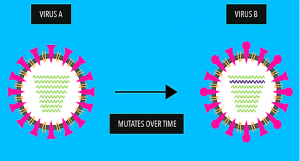
Figure 1: Viral mutation [observe the spikes (purple colored) and viral genome (green colored)]
Genetic mutations represent any event that changes the genetic structure or any alteration in the inherited nucleic acid sequence of the genotype of an organism (Presterl, Schahawi, & Reilly, 2021).
A virus is a piece of nucleic acid/genome, either a deoxyribonucleic acid (DNA) or ribonucleic acid (RNA), wrapped in a thin coat of protein and an outer envelope (see Figure 1). They can also be defined as ultramicroscopic infectious agent that replicates itself only within cells of living hosts to cause disease (Ward, 2012). For viruses, genetic mutations signify a change in the nucleic acid or genome of the virus that can affect the sequence of its other structures.
Implications of viral mutations include;
- Enhanced mode/rate of transmission
- Increased virulence i.e., the capacity of the virus to cause disease resulting in increased infections, hospitalization or death
- Reduction in the neutralization of viruses by antibodies
- Reduction in the effectiveness of therapeutics
- Reduction in detection of virus
- Ability to cause cancers
Two ways viruses mutate are called “antigenic drift” and “antigenic shift”.
Antigenic drift
As a virus replicates inside a host cell, i.e., when someone gets infected with a virus and the virus is growing/dividing/multiplying/making copies of itself inside the cells of the person, its genome can undergo random replication errors which are sometimes mediated by the virus or due to the replication process. These replication errors can lead to alterations in the viral surface proteins or usually called the antigens. Overtime, these replication errors amass and cause the antigens to drift, meaning, the surface proteins of the new emerging viruses look different than the original virus. Thus, the drift occurs due to small changes overtime in the genes of the genome of the viruses that lead to changes in the surface proteins of the virus.
Antigenic shift
An antigenic shift is a rapid major change in the genome or viral surface proteins or antigens of a virus. Antigenic shift can happen in four ways. They are;
- Recombination
- Recombination by independent assortment
- Recombination of incompletely linked genes
- Zoonotic transmission
- Recombination occurs when two different, but related, viruses infect a host cell at the same time. During the process of replication, the genomes of these two viruses interact to generate a new subtype of virus with genome and antigens that are a mixture of the original strains.
- Usually, the viral genome is a continuous strand. However, some viral genomes are segmented. Recombination by independent assortment occurs when two or more different viruses with segmented genomes infect a host cell. During the process of replication, the segmented genomes of these viruses can interact and assort at random. This can create a new subtype of virus with genome and antigens that are a mixture of the original strains.
- Recombination of incompletely linked genes occurs when the genes of the genome of viruses interact by combining with other genes at different sites of the viral genomes during replication. This can create a new subtype of virus with genome and antigens that are a mixture of the original strains.
- Zoonotic transmission occurs when a previously known virus that infects only animals makes a leap to infect humans. The whole process of replication of this virus that infects only animals but now replicating in human host cells creates a new subtype of virus with genome and antigens that are a mixture of the animal-human pair.
Antigenic drift and shift are one of the reasons why people can get viral infection repeatedly. Usually, antigenic shift gives rise to epidemics and pandemics.
COVID-19 and vaccination
We know that the COVID-19 pandemic started as a zoonotic transmission from the source city, Wuhan in China. Thus, it already began as an “antigenic shift” viral infection. So, the good news is that, the vaccines which have been made and continue to be formulated are against a “novel viral strain”. Though, this new strain will undergo mutations as is already been recorded, the vaccines will still be effective at neutralizing the viruses or boosting the immune system to “remember” and “fight” in the event of infection, because, most of the time, the mutations in the viral genome or antigens can be minor that, they do not significantly change how the virus works. They may take time before they drift and these changes also, do not happen at different places in the same time. They often begin as confined infections. Hence, the foundational framework of the virus from which the vaccines were formulated are rendered impotent. Also, even with the discovery of new strains, vaccination substantially, reduces the negative effects of infections or reinfections. As have been recorded around the world, vaccinations have reduced the number of cases that result in serious illnesses, hospitalizations and death.
Nonetheless, there is a cause to remain vigilant for the possibility of near or future antigenic changes in SARS CoV2 and to be prepared for several booster vaccinations if necessary. When viruses drift substantially or shift, therapeutics against the original strain of the virus may no longer work. Thus, therapeutics against viruses must be reviewed periodically.
What must we do?
Many factors contribute to how quickly viruses mutate and spread. One major factor is our human behaviour. To slow further mutations of the current SARS CoV2, we must adhere to the COVID-19 preventive protocols now more than ever. We must;
- Always wash our hands with soap under running water for at least 30 seconds
- Avoid touching our face
- Cough into a handkerchief or a tissue
- Wear face mask always
- Avoid crowded places
- Practice physical distancing
- Get vaccinated/Get booster vaccinations
This is our new way of living, let us do well.
References
Presterl, E., Schahawi, M., D-L., Reilly, J., S. (2021). Basic Microbiology and Infection Control for Midwives. Springer Nature Switzerland.
Ward, H., (2012). Oxford handbook of Epidemiology for Clinicians. Oxford University Press.
You may also like
-
RECRUITMENT OF A PHD RESEARCH FELLOW
14 July, 2025