Pentecost University
  • Apply Online
  • About
    • Vision, Mission & Values
    • The Vice-Chancellor
    • Administration
    • Pentecost University Council
    • Stakeholders
      • The Church of Pentecost
      • The Church of Pentecost Chairman Education Foundation (COPCEF)
      • Alumni
      • Parents and Guardians
      • Donors
      • Employers
      • Hiring Our Facilities
    • University Anthem
    • Collaborations
      • others
      • CIPS
    • Contact
      • Directions to Campus
      • Schedule a Visit
      • Staff Directory
      • Helplines
      • Contact Us
  • Admissions
    • Entry Requirements
    • Application Procedure
    • Application Forms
    • Tuition Fees and Student Online Payment
    • Mature Applicants
  • ACADEMICS
    • Undergraduate Programmes
    • Postgraduate Studies & Research
      • Message from the Director
      • Admission Requirements
      • Postgraduate Studies & Research Programmes
      • Tuition Fees
      • Sessions
      • Frequently Asked Questions
    • College of Foundation and Professional Studies (COFOPS)
    • Pentecost Centre for the study of Unreached People Groups (PCUPGs), Africa
    • Centre for Strategic Philanthropy & Social Investment (CESPSI)
    • Capacity Building, Corporate Engagement & Innovation Unit (CCI-Unit)
    • Our Library
      • Welcome to our Library
      • About Library
      • Library Catalogue
      • Library Help
      • Research
        • PentVars Business Journal
        • Students’ Research & Project Work
        • Staff Research & Publications
      • E-Resources
      • Online Public Access Catalogue (OPAC)
    • Faculties
      • International Digital Centre
      • Faculty of Law (LL.B)
      • School of Theology, Mission & Leadership (STML)
      • Faculty of Engineering Science and Computing (FESAC)
      • Faculty of Business Administration (FBA)
      • Faculty of Health and Allied Sciences (FHAS)
    • Academic Calendar
    • Sessions/Schools
  • Student Life
    • Scholarship
    • International
      • Students Experience, Diversity and International Relations (SEDIR) Office
      • Application Process
      • Tuition Fees
      • Entry Requirements
      • Immigration Issues & Permits
      • Student Life
      • Partnerships
      • Frequently Asked Questions
      • Contact Us
    • Dean of Students
    • The Students’ Representative Council (SRC)
    • Chaplaincy
    • Counselling Unit
    • University Assembly
    • Mentorship
    • Lodging
    • Clubs and Societies
    • Sports and Entertainment
    • Photo Gallery
  • News
  • Vacancies
  • Apply Online
  • About
    • Vision, Mission & Values
    • The Vice-Chancellor
    • Administration
    • Pentecost University Council
    • Stakeholders
      • The Church of Pentecost
      • The Church of Pentecost Chairman Education Foundation (COPCEF)
      • Alumni
      • Parents and Guardians
      • Donors
      • Employers
      • Hiring Our Facilities
    • University Anthem
    • Collaborations
      • others
      • CIPS
    • Contact
      • Directions to Campus
      • Schedule a Visit
      • Staff Directory
      • Helplines
      • Contact Us
  • Admissions
    • Entry Requirements
    • Application Procedure
    • Application Forms
    • Tuition Fees and Student Online Payment
    • Mature Applicants
  • ACADEMICS
    • Undergraduate Programmes
    • Postgraduate Studies & Research
      • Message from the Director
      • Admission Requirements
      • Postgraduate Studies & Research Programmes
      • Tuition Fees
      • Sessions
      • Frequently Asked Questions
    • College of Foundation and Professional Studies (COFOPS)
    • Pentecost Centre for the study of Unreached People Groups (PCUPGs), Africa
    • Centre for Strategic Philanthropy & Social Investment (CESPSI)
    • Capacity Building, Corporate Engagement & Innovation Unit (CCI-Unit)
    • Our Library
      • Welcome to our Library
      • About Library
      • Library Catalogue
      • Library Help
      • Research
        • PentVars Business Journal
        • Students’ Research & Project Work
        • Staff Research & Publications
      • E-Resources
      • Online Public Access Catalogue (OPAC)
    • Faculties
      • International Digital Centre
      • Faculty of Law (LL.B)
      • School of Theology, Mission & Leadership (STML)
      • Faculty of Engineering Science and Computing (FESAC)
      • Faculty of Business Administration (FBA)
      • Faculty of Health and Allied Sciences (FHAS)
    • Academic Calendar
    • Sessions/Schools
  • Student Life
    • Scholarship
    • International
      • Students Experience, Diversity and International Relations (SEDIR) Office
      • Application Process
      • Tuition Fees
      • Entry Requirements
      • Immigration Issues & Permits
      • Student Life
      • Partnerships
      • Frequently Asked Questions
      • Contact Us
    • Dean of Students
    • The Students’ Representative Council (SRC)
    • Chaplaincy
    • Counselling Unit
    • University Assembly
    • Mentorship
    • Lodging
    • Clubs and Societies
    • Sports and Entertainment
    • Photo Gallery
  • News
  • Vacancies

Health Education

  • Home
  • News
  • Health Education
  • Health Scientist at Pentecost University Highlight the Value of Regular Vital Signs Monitoring

Health Scientist at Pentecost University Highlight the Value of Regular Vital Signs Monitoring

  • Posted by pentvars
  • Categories Health Education, News
  • Date Aug 29, 2022
  • Comments 2,264 comments


Click to download Pdf: Vital Signs


THE VALUE OF REGULAR MONITORING OF YOUR VITAL SIGNS – A QUICK READ

By:

Mr. Reginald Arthur-Mensah Jnr, David Sablah & Dr. Abigail Kyei

Department of Nursing and Midwifery, Pentecost University.


Introduction

Vital signs are important biological, biochemical, physiological and hormonal indicators of a person’s general health status. They are the objective measurements of the body’s most basic operations. Their processes perform essential functions for the living body. They are “vital” because they are urgently needed; absolutely necessary; a manifestation and sign of life. Even in triaging patients i.e., assessing or sorting patients according to importance or urgency of clinical presentation, the first set of clinical examinations is an evaluation of the vital signs of the patient.

Traditionally, vital signs include the body’s temperature, blood pressure, pulse rate, respiratory rate and oxygen saturation. Generally, vital signs provide a snapshot of what is going on in the body, if the values are outside the normal range, they may point to a dysfunction in the body.

Below are brief descriptions of the vital signs and the dysfunctions they may point to.


Body temperature

The normal internal body temperature ranges from 36.5 to 37.2 degrees Celsius (Check to verify if you are in this range). Usually, fluctuations in this value indicate there has been a microbial exposure and the body is fighting an infection. When there is a microbial exposure in the body, the immune system sends signals to the hypothalamus to increase the body’s temperature. This process in turn weakens the invading microorganisms and allows the specific body’s immune cells to respond appropriately, halting the pathogenesis of the microorganism. Upon successful victory by the immune cells, the body temperature will return to normal. However, prolong elevated body temperature needs a medical attention.


Blood pressure

The blood pressure is the pressure of the circulating blood against the walls of the blood vessels. Two numbers i.e., a numerator and a denominator are recorded when measuring blood pressure. The numerator (the systolic pressure/higher value) displays the pressure inside the artery when the heart pumps blood to the body. The denominator (the diastolic pressure/lower value) represents artery pressure when the heart is at rest. The blood pressure is considered normal at 120/80 mmHg (millimeters of mercury) (Check to verify if you have this value). Usually, fluctuations in this value indicate a concern for the health of the heart and brain and it associated blood vessels. E.g., coronary heart disease (heart attack), hypertension or stroke (brain attack).


Pulse rate

The pulse rate is the number of times the heart beats in a minute. It ranges from 60 to 100 beats per minute (bpm) (Check to verify if you are in this range). Usually, fluctuations in this value indicate a concern for the health of the heart and its associated blood vessels.


Respiratory rate

The respiratory rate is the number of times anyone breathes in a minute. It ranges from 12 to 20 breaths per minute (bpm). (Check to verify if you are in this range). Usually, fluctuations in this value indicate signs of respiratory illness, signs of a respiratory allergic exposure, respiratory poisoning, heart disease, lung infections, signs of a general infection and emotional changes.


Oxygen saturation

Hemoglobin is a hemoprotein (blood protein) composed of “globin” (colourless protein obtained by removing heme from hemoglobin) and “heme” (the oxygen carrying compound in red blood cells that gives red blood cells their characteristic colour) which functions primarily to transport oxygen from the lungs to body tissues. Oxygen saturation means the amount of oxygen absorbed by the hemoglobin relative to the total hemoglobin in the blood. It ranges from 95 to 100%. (Check to verify if you are in this range). Usually, fluctuations in this value indicate the lack of adequate oxygen rich–hemoglobin reaching the organs of the body. This can compromise various organ functions.


Take note however, that, many sources of internal and external variables affect the scores of these vital signs. E.g., age, external temperature, physical activity, pregnancy etc. Nonetheless, vital signs monitoring is the critical first step for a healthy and long life. Be intentional about monitoring your vital signs and you will save yourself.

Are you ready to monitor your vital signs but do not have the equipment and skill? Visit us at the Department of Nursing and Midwifery, Pentecost University and we will be happy to help.


Thank you.


#AtPentvars
#PentvarsNursingMidwifery
#TransformationAndService

  • Share:
pentvars

Previous post

Pentecost University Receives Top International Award of Merit
Aug 29, 2022

Next post

Side Effects of Chemotherapy among Women with Breast Cancer – A Sample Analysis from Accra, Ghana.
Oct 25, 2022

You may also like

  • WhatsApp Image 2025-07-11 at 02.52.03 (1)
    RECRUITMENT OF A PHD RESEARCH FELLOW
    14 July, 2025
  • WhatsApp Image 2025-07-05 at 13.14.56_f5a5bbd4
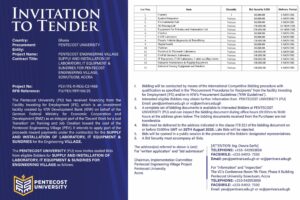
    Pentecost University Invites Bids for Major Engineering Village Project
    9 July, 2025
  • AN6A0732
    Pentecost University Partners with Alveus Development to Train 10,000 Electricians and Engineers in Sustainable Transportation and Renewable Energy
    2 June, 2025

Leave A Reply

Your email address will not be published. Required fields are marked *

Search

Quick Links

  • E-Learning
  • IT Certifications
  • Email
  • E-Library
  • E-Portal
  • Resources
  • Photo Gallery
  • Staff Directory

Admissions

  • Application Procedure
  • Academic Calendar
  • Tuition Fees and Student Online Payment
  • Application Forms
  • Entry Requirements
  • Student Online Payment

Online Services

  • Parents Portal
  • E-Learning
  • E-Library
  • Undergradraduate ePortal
  • Postgraduate ePortal
  • IDC – Engineering Programme
  • Online Public Access Catalogue (OPAC)

Quick Links

  • Alumni
  • Our Library
  • Photo Gallery
  • The Church of Pentecost
  • Pentvars Journal
  • FAQs
  • Staff Directory

Contact

P. O. Box KN 1739
Kaneshie, Accra
info@pentvars.edu.gh
+233283094284/+233302417057/8
Pentecost University College campus location

© 2021 Pentecost University. All Rights Reserved Developed By: Samuel Armah (Alumni - 2011) & Emmanuel Assimeku (Alumni - 2012)

Sponsored By: Engisys Limited