Pentecost University
  • Apply Online
  • About
    • Vision, Mission & Values
    • The Vice-Chancellor
    • Administration
    • Pentecost University Council
    • Stakeholders
      • The Church of Pentecost
      • The Church of Pentecost Chairman Education Foundation (COPCEF)
      • Alumni
      • Parents and Guardians
      • Donors
      • Employers
      • Hiring Our Facilities
    • University Anthem
    • Collaborations
      • others
      • CIPS
    • Contact
      • Public Relations & Media Unit
      • Directions to Campus
      • Schedule a Visit
      • Staff Directory
      • Helplines
      • Contact Us
  • Admissions
    • Entry Requirements
    • Application Procedure
    • Application Forms
    • Tuition Fees and Student Online Payment
    • Mature Applicants
  • ACADEMICS
    • Undergraduate Programmes
    • Postgraduate Studies & Research
      • Message from the Director
      • Admission Requirements
      • Postgraduate Studies & Research Programmes
      • Tuition Fees
      • Sessions
      • Frequently Asked Questions
    • College of Foundation and Professional Studies (COFOPS)
    • Pentecost Centre for the study of Unreached People Groups (PCUPGs), Africa
    • Centre for Strategic Philanthropy & Social Investment (CESPSI)
    • Capacity Building, Corporate Engagement & Innovation Unit (CCI-Unit)
    • Our Library
      • Welcome to our Library
      • About Library
      • Library Catalogue
      • Library Help
      • Research
        • PentVars Business Journal
        • Students’ Research & Project Work
        • Staff Research & Publications
      • E-Resources
      • Online Public Access Catalogue (OPAC)
    • Faculties
      • International Digital Centre
      • Faculty of Law (LL.B)
      • School of Theology, Mission & Leadership (STML)
      • Faculty of Engineering Science and Computing (FESAC)
      • Faculty of Business Administration (FBA)
      • Faculty of Health and Allied Sciences (FHAS)
    • Academic Calendar
    • Sessions/Schools
  • Student Life
    • Scholarship
    • International
      • Students Experience, Diversity and International Relations (SEDIR) Office
      • Application Process
      • Tuition Fees
      • Entry Requirements
      • Immigration Issues & Permits
      • Student Life
      • Partnerships
      • Frequently Asked Questions
      • Contact Us
    • Dean of Students
    • The Students’ Representative Council (SRC)
    • Chaplaincy
    • Counselling Unit
    • University Assembly
    • Mentorship
    • Lodging
    • Clubs and Societies
    • Sports and Entertainment
    • Photo Gallery
  • News
  • Vacancies
  • Apply Online
  • About
    • Vision, Mission & Values
    • The Vice-Chancellor
    • Administration
    • Pentecost University Council
    • Stakeholders
      • The Church of Pentecost
      • The Church of Pentecost Chairman Education Foundation (COPCEF)
      • Alumni
      • Parents and Guardians
      • Donors
      • Employers
      • Hiring Our Facilities
    • University Anthem
    • Collaborations
      • others
      • CIPS
    • Contact
      • Public Relations & Media Unit
      • Directions to Campus
      • Schedule a Visit
      • Staff Directory
      • Helplines
      • Contact Us
  • Admissions
    • Entry Requirements
    • Application Procedure
    • Application Forms
    • Tuition Fees and Student Online Payment
    • Mature Applicants
  • ACADEMICS
    • Undergraduate Programmes
    • Postgraduate Studies & Research
      • Message from the Director
      • Admission Requirements
      • Postgraduate Studies & Research Programmes
      • Tuition Fees
      • Sessions
      • Frequently Asked Questions
    • College of Foundation and Professional Studies (COFOPS)
    • Pentecost Centre for the study of Unreached People Groups (PCUPGs), Africa
    • Centre for Strategic Philanthropy & Social Investment (CESPSI)
    • Capacity Building, Corporate Engagement & Innovation Unit (CCI-Unit)
    • Our Library
      • Welcome to our Library
      • About Library
      • Library Catalogue
      • Library Help
      • Research
        • PentVars Business Journal
        • Students’ Research & Project Work
        • Staff Research & Publications
      • E-Resources
      • Online Public Access Catalogue (OPAC)
    • Faculties
      • International Digital Centre
      • Faculty of Law (LL.B)
      • School of Theology, Mission & Leadership (STML)
      • Faculty of Engineering Science and Computing (FESAC)
      • Faculty of Business Administration (FBA)
      • Faculty of Health and Allied Sciences (FHAS)
    • Academic Calendar
    • Sessions/Schools
  • Student Life
    • Scholarship
    • International
      • Students Experience, Diversity and International Relations (SEDIR) Office
      • Application Process
      • Tuition Fees
      • Entry Requirements
      • Immigration Issues & Permits
      • Student Life
      • Partnerships
      • Frequently Asked Questions
      • Contact Us
    • Dean of Students
    • The Students’ Representative Council (SRC)
    • Chaplaincy
    • Counselling Unit
    • University Assembly
    • Mentorship
    • Lodging
    • Clubs and Societies
    • Sports and Entertainment
    • Photo Gallery
  • News
  • Vacancies

Health Education

  • Home
  • News
  • Health Education
  • Vaccines, Vaccination and the four types of COVID-19 Vaccines – Dr Kyei, Mr Arthur-Mensah, Mr Adu-Gyamfi

Vaccines, Vaccination and the four types of COVID-19 Vaccines – Dr Kyei, Mr Arthur-Mensah, Mr Adu-Gyamfi

  • Posted by pentvars
  • Categories Health Education, News, Nursing
  • Date Mar 22, 2021
  • Comments 8,917 comments

Vaccines, Vaccination and the four types of COVID-19 Vaccines

Mr. Reginald Arthur-Mensah1, Mr. Paa Kofi Tawiah Adu-Gyamfi1 & Dr. Abigail Kyei1.

1Department of Nursing and Midwifery, Pentecost University.


The control of COVID-19 has seen vaccine development move at record speed with more than 170 different vaccines in trials. But how are these vaccines prepared and how will they protect us against the disease? Before we delve into that, let us understand what vaccines and their related procedures are.


Vaccines

Vaccines are products that help the immune system combat invading disease-causing microorganisms of the body (Coelho, 2020). They are scientifically prepared biological formulations that provide protection to the body from certain diseases (Tortora, Funke & Case, 2019).

Vaccines can be administered via;

  • Oral route – administered through the mouth
  • Intranasal route – administered through the nose
  • Subcutaneous route – Injected into an area just beneath the skin
  • Intramuscular route – injected into the muscles
  • Intradermal route – injected into layers of the skin (CDC, 2021).


Vaccination

Vaccination is the act of receiving a vaccine as protection against contracting certain particular diseases (WHO, 2021).


The principle of vaccines and vaccination

Vaccines contain suspensions of weakened, killed, fragmented, toxins of microorganisms or antibodies to certain microorganisms (Brunson, 2020). Vaccines train the immune system to detect and fight diseases-causing microorganisms. Vaccines and vaccination teach the immune system to “destroy” and “remember” diseases-causing microorganisms (see Figure 1). This act begins the process of immunization/immunity to that particular disease or diseases (CDC, 2021).

Vaccination is the safest, simple and effective method of protecting people from certain harmful diseases before they come into contact with them. Unlike most medicines, which treat and/or cure diseases, vaccines prevent diseases.
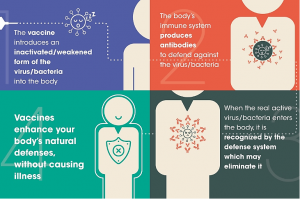
Figure 1: How vaccines work

Source: Brunson, (2020).


The four major types of COVID-19 vaccines

There are more vaccine candidates simultaneously in the pipeline for COVID-19 than ever before for an infectious disease. All of them are trying to achieve the same thing; immunity to the virus. They do so by stimulating an immune response to an antigen, a molecule found on the virus. In the case of COVID-19, the antigen is typically the characteristic spike protein (S protein) found on the surface of the virus, which it normally uses to help it invade human cells (see Figure 2).

There are four categories of COVID-19 vaccines in clinical trials. They include; whole virus, protein subunit, nucleic acid (RNA and DNA) and viral vector (Gavi, 2021).
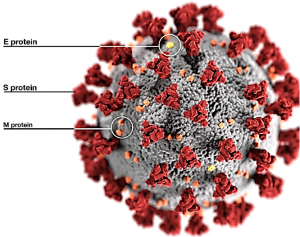
Figure 2: SARS CoV 2 (Causative agent of COVID-19)

Source: Coelho, 2020.


Whole virus

Whole virus vaccines use a weakened (attenuated) or deactivated form of the virus that causes a disease to trigger protective immunity to it. There are two types of whole virus vaccines. Live attenuated vaccines use a weakened form of the virus, which can still grow and replicate, but does not cause illness. Inactivated vaccines contain viruses whose genetic material has been destroyed by heat, chemicals or radiation so that they cannot infect cells and replicate, but can still trigger an immune response.


Protein subunits (fragments of microbes)

Rather than injecting a whole virus to trigger an immune response, subunit vaccines (sometimes called acellular vaccines) contain purified pieces of it, which have been specially selected for their ability to stimulate immune cells. Because these fragments are incapable of causing disease, subunit vaccines are considered very safe. There are several types: protein subunit vaccines contain specific isolated proteins from viral or bacterial pathogens; polysaccharide vaccines contain chains of sugar molecules (polysaccharides) found in the cell walls of some bacteria; conjugate subunit vaccines bind a polysaccharide chain to a carrier protein to try and boost the immune response. However, the immune response might be weak.


Nucleic acids

Nucleic acid vaccines use genetic material from a disease-causing virus or bacterium to stimulate an immune response against it. Depending on the vaccine, the genetic material could be DNA or RNA; in both cases it provides the instructions for making a specific protein from the pathogen, which the immune system will recognise as foreign (an antigen). Once injected into host cells, this genetic material is read by the cell’s own protein-making machinery and used to manufacture antigens, which then trigger an immune response. Since the antigens are produced using the body’s own cells and in large quantities, the immune reaction is strong.


Viral vectors

Viral vector-based vaccines differ from most conventional vaccines in that they don’t actually contain antigens, but rather use the body’s own cells to produce them. They do this by using a modified virus (the vector) to deliver genetic code for antigen, in the case of COVID-19, spike proteins found on the surface of the virus, into human cells. By infecting cells and instructing them to make large amounts of antigen, which then trigger an immune response, the vaccine mimics what happens during natural infection with certain pathogens, especially viruses. This has the advantage of triggering a strong cellular immune response by T cells as well the production of antibodies by B cells.


Vaccines are the new tool in the fight against COVID-19 and it is hugely encouraging to see so many vaccines proving successful and going into development. Working as quickly as they can, scientists from across the world are collaborating and innovating to bring us treatments and vaccines that will collectively save lives and end this pandemic.

However, but for the foreseeable future we must continue wearing face protection, practicing hand hygiene, practicing respiratory hygiene and ensuring physical distancing and all the other specific COVID-19 safety protocols. Being vaccinated does not mean that we can throw caution to the wind and put ourselves and others at risk, we must continue to live safe.


References

Brunson, E., K. (2020). Vaccines. Encyclopaedia Britannica. (Accessed March 20, 2021).

CDC, (2021). Vaccines: The Basics. Retrieved from https://www.cdc.gov/vaccines/vpd/vpd-vac-basics.html. (Accessed March 18, 2021).

Coelho, S., (2020). What is a vaccine? Types, stages for approval. Retrieved from https://www.medicalnewstoday.com/articles/what-is-a-vaccine. (Accessed March 20, 2021).

Gavi (2021). The four types of COVID-19 vaccines. Retrieved from https://www.gavi.org/vaccineswork/. (Accessed March 17, 2021).

Tortora, G., J., Funke, B., R., & Case, C., L., (2019). Microbiology: An introduction. Pearson Education Inc, Boston, USA.

WHO, (2021). Vaccines and Immunization: What is vaccination? Retrieved from https://www.who.int/news-rrom/q-a-detail/vaccines-and-immunzation. (Accessed March 19, 2021).


Click to download PDF: Vaccines, Vaccination and the four types of COVID-19 Vaccines (1)

  • Share:
pentvars

Previous post

Pentecost University Welcomes CoP Women's Ministry Director
Mar 22, 2021

Next post

Pentecost University Student Wins National Francophonie Award
Mar 26, 2021

You may also like

  • WhatsApp Image 2025-07-11 at 02.52.03 (1)
    RECRUITMENT OF A PHD RESEARCH FELLOW
    14 July, 2025
  • WhatsApp Image 2025-07-05 at 13.14.56_f5a5bbd4
    Pentecost University Invites Bids for Major Engineering Village Project
    9 July, 2025
  • AN6A0732
    Pentecost University Partners with Alveus Development to Train 10,000 Electricians and Engineers in Sustainable Transportation and Renewable Energy
    2 June, 2025

Leave A Reply

Your email address will not be published. Required fields are marked *

Search

Quick Links

  • E-Learning
  • IT Certifications
  • Email
  • E-Library
  • E-Portal
  • Resources
  • Photo Gallery
  • Staff Directory

Latest News

Pentecost University Expands Community Impact Through Innovation Hub Partnership with Alex Nerda Centre
02Feb2026
Pentecost University and Vice-Chancellor Honoured with Dual Awards
01Oct2025

Admissions

  • Application Procedure
  • Academic Calendar
  • Tuition Fees and Student Online Payment
  • Application Forms
  • Entry Requirements
  • Student Online Payment

Online Services

  • Parents Portal
  • E-Learning
  • E-Library
  • Undergradraduate ePortal
  • Postgraduate ePortal
  • IDC – Engineering Programme
  • Online Public Access Catalogue (OPAC)

Quick Links

  • Alumni
  • Our Library
  • Photo Gallery
  • The Church of Pentecost
  • Pentvars Journal
  • FAQs
  • Staff Directory

Contact

P. O. Box KN 1739
Kaneshie, Accra
info@pentvars.edu.gh
+233283094284/+233302417057/8
Pentecost University College campus location

© 2021 Pentecost University. All Rights Reserved Developed By: Samuel Armah (Alumni - 2011) & Emmanuel Assimeku (Alumni - 2012)

Sponsored By: Engisys Limited