The New Covid-19 Viral Strain; What We Need To Know – Mr Arthur-Mensah & Dr Mrs Abigail Kyei

Mr Reginald Arthur-Mensah Jnr (Department of Nursing and Midwifery, Pentecost University)
Dr Mrs Abigail Kyei (Department of Nursing and Midwifery, Pentecost University)
Introduction
A new strain of the SARS-COV2, the virus causing the ongoing COVID-19 pandemic, of the coronavirus family, threatens to further overburden the already overwhelmed health care facilities and systems across the globe. The new strain is the SARS-COV2 VUI 202012/01 or B.1.1.7. The strain was first detected in September 2020, in southeastern England and has since accounted for about 60% of cases in the country.
Features of the new strain of the virus
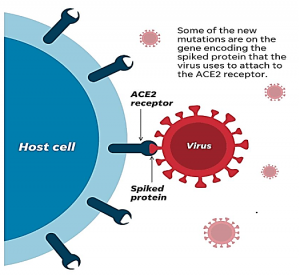
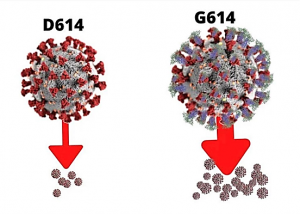
The new strain has several genetic mutations especially on its “spike proteins” on the viral cell surface which it uses to attach to the human host cells (see Figure 1 and 2). Thus, this makes the new strain attach to the human host cells more readily and efficiently making it easier for the virus to enter into the host cells to cause disease. It is estimated that these mutations can make the virus up to 70% more transmissible. However, there is no evidence that it is linked to a higher risk of hospital admissions or deaths. At least, 17 mutations in the spike proteins have been identified but mutation G614 is of urgent concern. (see Figure 2).
Countries the new stain has been detected
The new strain has been detected in about 33 countries including; Australia, Belgium, Brazil, Canada, Chile, China, Denmark, Finland, France, Germany, Iceland, India, Ireland, Israel, Italy, Japan, Jordan, Lebanon, Malta, The Netherlands, Norway, Pakistan, Portugal, Singapore, South Korea, Spain, Sweden, Switzerland, Taiwan, Turkey, the United Arab Emirates, the United Kingdom and the United States of America.
In Africa, South Africa also identified a strain similar to the B.1.1.7 in October. The strain is B.1.351. It appears to spread more easily and quickly but it is not more severe. Another variant has recently been detected in Nigeria, but there is no evidence of easy transmissibility and higher virulence.
The new strain and the COVID-19 vaccines
Current evidence suggests that most mutations of the new strain are on the viral spike proteins as earlier mentioned. It is these spike proteins the COVID-19 vaccines target. The vaccines are expected to elicit antibody reactions against many parts of the viral spike proteins; hence, it is unlikely that a single new mutation in the virus will make the vaccine less effective.
What to expect
The virus that causes COVID-19 will keep changing. That is what simply happens to microorganisms as they continue their infectivity in human populations. The scientific community continues to sample positive cases for new strains of the virus. However, it is unlikely to predict how the viral mutations might affect the pathophysiology of the disease until large data are analyzed.
Preventive measures against the new strain
The preventive measures against this new strain follow the precautionary and preventive measures against the original strain. They include;
- The regular washing of hands with soap under running water.
- The intermittent sanitizing of the hands with an alcohol-based hand rub.
- Avoidance of touching the T zone of the face as well as the eyes, nose and mouth.
- Wearing of face protection e.g., nose masks, face shields at all times.
- Practising physical distancing and staying away from crowds and large groups of people.
- Refraining from smoking and other activities that weaken the lungs.
- Staying home if one feels unwell.
This new strain may be more infective, but it still relies on humans to spread it. Let us stop the spread of the virus by adhering to all the precautionary measures stated above. Let us all endeavour to stay safe. As of January 3, 2021, over 85 million people have been infected with the virus, 48 million people have recovered from the disease with about 1.8 million deaths worldwide (WHO, COVID-19, 2021)
References
Strains of Coronavirus. Retrieved from https://www.webmd.com/lung/coronavirus-strains. (Accessed January 2, 2021).
WHO Coronavirus Disease (COVID-19) Dashboard. Retrieved from https://covid19.who.int. (Accessed January 3, 2021).
You may also like
-
RECRUITMENT OF A PHD RESEARCH FELLOW
14 July, 2025